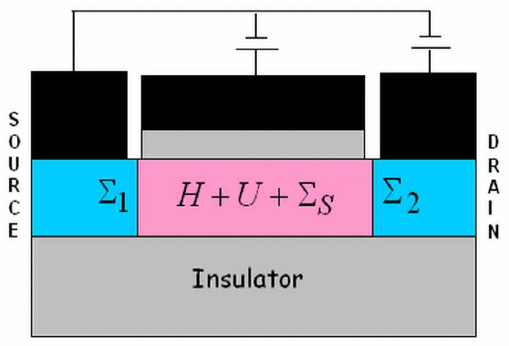
The non-equilibrium Greens function (NEGF) formalism provides a powerful conceptual and computational framework for treating quantum transport in nanodevices. It goes beyond the Landauer approach for ballistic, non-interacting electronics to include inelastic scattering and strong correlation effects at an atomistic level.
NEGF is generally regarded as an esoteric tool for specialists, but we believe it should be a part of the standard training of science and engineering students.
For the convenience of interested students we have set up a Q&A forum along with tutorial materials open to all.
Tutorial Papers
- S. Datta, “Nanoscale Device Simulation: The Green’s Function Method,” Superlattices and Microstructures, 28, 253-278 (2000).
- S. Datta, “Non-Equilibrium Green’s Function (NEGF) Formalism: An elementary Introduction,” Proceedings of the International Electron Devices Meeting (IEDM), IEEE Press (2002). (preprint)-
- S. Datta, “Electrical resistance: an atomic view,” Nanotechnology, 15, S433-S451 (2004).
- M. P. Anantram, M. S. Lundstrom and D. E. Nikonov, “Modeling of Nanoscasle Devices,” http://arxiv.org/abs/cond-mat/0610247v2 (2007). -
- M. Paulsson, “Non Equilibrium Green’s Functions for Dummies: Introduction to the One Particle NEGF equations,” arXiv.org cond-mat/0210519 (2002). -
- E. Polizzi, and S. Datta, “Multidimensional Nanoscale device modeling: the Finite Element Method applied to the Non-Equilibrium Green’s Function formalism,” IEEE-NANO 2003. Third IEEE Conference on Nanotechnology, 2, 40-43 (2003). -
- A. P. Jauho, “Introduction to the Keldysh nonequilibrium Green function technique,” -
Online Seminars
- Datta: CQT: Concepts of Quantum Transport (4 part lecture)
- Datta: Nanodevices: A Bottom-up View
- Klimeck: NEMO 1-D: The First NEGF-based TCAD Tool and Network for Computational Nanotechnology
- Klimeck: Numerical Aspects of NEGF: The Recursive Green Function Algorithm
- Lundstrom: A Top-Down Introduction to the NEGF Approach
Simulators
- Resonant Tunneling Diode Simulation with NEGF:Compute charge and current through a resonant tunneling diode and multi-barrier heterostructures in a single band effective mass approximation.
- NanoMOS: 2-D simulator for thin body (< 5 nm), fully depleted, double-gated n-MOSFETs.
- Nanowire: Simulate electron transport in 3D through nanowires in the effective mass approximation subject to 3D Poisson solution
- Multi-gate Nanowire FET: 3D Simulator for Silicon Nanowire Field Effect Transistors with Multiple Gates
Research Publications
NEGF simulation of semiconductor devices at the tight binding or Huckel level:
- Gerhard Klimeck, Roger K. Lake, R. Chris Bowen, William R. Frensley and Ted Moise,, “Quantum Device Simulation with a Generalized Tunneling Formula,” Appl. Phys. Lett., 67, 2539, 1995.
- R. C. Bowen, G. Klimeck, R. Lake, W. R. Frensley and T. Moise,, “Quantitative Resonant Tunneling Diode Simulation,” J. Appl. Phys., 81, 3207, 1997.
- R. Lake, G. Klimeck, R. C. Bowen and D. Jovanovic, “Single and multiband modeling of quantum electron transport through layered semiconductor devices,” J. Appl. Phys., 81, 7845, 1997.
- J. Guo, S. Datta, M.S. Lundstrom and M.P. Anantram, “Towards Multiscale Modeling of Carbon Nanotube Transistors,” International J. on Multiscale Computational Engineering, special issue on multiscale methods for emerging technologies, ed. N. Aluru, 2, 257-276, 2004. (a treatment of carbon nanotube transistors by a pz orbital, tight-binding method)-
- M. Paulsson, F. Zahid, and S. Datta, “Resistance of a Molecule,” chapter in Handbook of Nanotechnology, ed. S. Lyshevski, Press, 2002, ISBN: 0-849312000. (Huckel approach for molecules)-
- F. Zahid, M. Paulsson, and S. Datta, “Electrical Conduction in Molecules,” chapter in Advanced Semiconductors and Organic Nano-Techniques, ed. H. Morkoc, Academic Press, 2003, ISBN: 0-12-507060-8. (Huckel approach for molecules)-
NEGF simulation of nanoscale transistor at the effective mass level:
- Z. Ren, R. Venugopal, S. Goasguen, S. Datta and M. S. Lundstrom, “nanoMOS 2.5: A Two-Dimensional Simulator for Quantum Transport in Double-Gate MOSFETs,” IEEE Trans. Electron. Dev., special issue on Nanoelectronics, 50, 1914-1925, 2003. -
- R. Venugopal, Z. Ren, S. Datta, and M. S. Lundstrom, “Simulating Quantum Transport in Nanoscale Transistors: Real versus Mode-Space Approach,” J. Appl. Phys., 92, 3730-3739, 2002. -
- R. Venugopal, S. Goasguen, S. Datta, and M. S. Lundstrom, “A Quantum Mechanical Analysis of Channel Access, Geometry and Series Resistance in Nanoscale Transistors,” J. Appl. Phys., 95, 292-305, 2004. -
- J. Wang, E. Polizzi, and M. S. Lundstrom, “A Three-Dimensional Quantum Simulation of Silicon Nanowire Transistors with the Effective Mass Approximation,” J. Appl. Phys., 96, 2192, 2004. -
NEGF simulation at the ab initio level
- P.S. Damle, A.W. Ghosh, and S. Datta, “Nanoscale Device Modeling,” chapter I in Molecular Nanoelectronics, ed. M. Reed and T. Lee, Scientific Publishers, 2003, ISBN: 1-58883-006-3.
- P.S. Damle, A.W. Ghosh, and S. Datta, “First-principles Analysis of Molecular Conduction Using Quantum Chemistry Software,” Chem. Phys., 281, 171-188, 2002.
- P.S. Damle, A.W. Ghosh, and S. Datta, “Unified Description of Molecular Conduction: From Molecules to Metallic Wires,” Phys. Rev. B, 64, Rapid Communication, 201403-1-201403-4, 2001.
NEGF in Phonon Transport
- N. Mingo and Y. Liu, “Phonon Transport in Amorphous-Coated Nanowires: an Atomistic Green Function Approach,” Phys. Rev. B, 70, 249901, 2004.
Related Ph.D. Theses
- Roger Lake, “Application of the Keldysh Formalism to Quantum Device Modeling and Analysis”, Ph.D. Thesis, Purdue University, 1992. -
- Gerhard Klimeck, “Electron-Phonon and Electron-Electron Interactions in Quantum Transport” Purdue University, 1994. -
- Zhibin Ren, “Nanoscale MOSFETs: Physics, Simulation, and Design,” Ph.D. Thesis, Purdue University, December 2001. -
- Prashant Damle, “Nanoscale Device Modeling: From MOSFETs to Molecules,” Ph.D. Thesis, Purdue University, May 2003.. copy)-
- Ramesh Venugopal, “Modeling Quantum Transport in Nanoscale Transistors,” Ph.D. Thesis, Purdue University, August 2003. copy)-
- Jing Guo, “Carbon Nanotube Electronics: Modeling and Physics,” Ph.D. Thesis, Purdue University, August 2004. copy)-
- Jing Wang, “Device Physics and Simulation of Silicon Nanowire Transistors,” Ph.D. Thesis, Purdue University, August 2005. -
- M. Luisier, “Quantum Transport for Nanostructures,” (2005) -
Online Classes
- Datta: Atom to Transistor, earlier teachings: graduate level
- Datta: Fundamentals of Nanoelectronics, earlier teachings: undergraduate level
Downloads
- Datta: MATLAB Scripts for "Quantum Transport: Atom to Transistor"
- Koswatta/Nikonov: MOSCNT: code for carbon nanotube transistor simulation (Matlab)
- Nikonov: Scripts for “recursive algorithm for NEGF in Matlab“
- NanoMOS 2.5 Source Code Download
Standard References
Most device simulation is based on models that neglect interactions or at best treat them to first order, for which simple treatments are adequate. But here are a few standard references and review articles on the NEGF formalism all of which are based on the use of advanced concepts like the “Keldysh contour”, which are needed for a systematic treatment of higher order interactions.
Infinite homogeneous media:
- Martin, P. C. and Schwinger, J., “Theory of many-particle systems,” Phys. Rev. 115, 1342, 1959.
- Kadanoff, L. P. and Baym, G., Quantum Statistical Mechanics, Frontiers in Physics Lecture Note Series, WA Benjamin, New York, 1962, now published by Perseus Books, ISBN: 020141046X
- Keldysh, L. V., “Diagram technique for non-equilibrium processes,” Sov. Phys. JETP, 20, 1018, 1965.
- Danielewicz, P., “Quantum theory of non-equilibrium processes,” Ann. Phys., 152, 239, 1984.
- Rammer, J. and Smith, H., “Quantum field-theoretical methods in transport theory of metals,” Rev. Mod. Phys., 58, 323, 1986.
- Mahan, G. D., “Quantum transport equation for electric and magnetic fields,” Phys. Rep, 145, 251, 1987.
- Khan, F. S., Davies, J. H. and Wilkins, J. W., “Quantum transport equations for high electric fields,” Phys. Rev. B, 36, 2578, 1987.
Finite structures: Many authors have applied the NEGF formalism to problems involving finite structures.
- E.V. Anda and F. Flore, “The role of inelastic scattering in resonant tunneling heterostructures,” J. Phys. Cond. Matt., 3, 9087, 1991.
- C. Caroli, R. Combescot, P. Nozieres and D. Saint-James, “A direct calculation of the tunneling current: IV. Electron-phonon interaction effects,” J. Phys. C: Solid State Physics, 5, 21, 1972.
- Y. Meir and N.S. Wingreen, “Landauer Formula for the Current through an Interaction Electron Region,” Phys. Rev. Lett., 68, 2512, 1992.
- S. Datta, “A simple kinetic equation for steady-state quantum transport,” J. Phys. Cond. Matt., 2, 8023, 1990.
- A.P. Jauho, N.S. Wingreen and Y. Meir, “Time-dependent transport in interacting and non-interacting resonant tunneling systems,” Phys. Rev. B, 50, 5528, 1994.
- H. Haug and A.P. Jauho, Quantum Kinetics in Transport and Optics of Semiconductors, Springer, Berlin, 1996, ISBN: 3540616020