CQT: Concepts of Quantum Transport
Newer version available
Category
Published on
Abstract
 |
Note: For an expanded version of these lectures see Datta's 2008 NCN@Purdue Summer School presentations on
Nanoelectronics and the Meaning of Resistance.
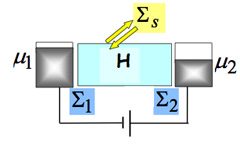
How does the resistance of a conductor change as we shrink its length
all the way down to a few atoms? This is a question that has
intrigued scientists for a long time, but it is only during the last
twenty years that it has become possible for experimentalists to
provide clear answers, leading to enormous progress in our
understanding. There is also great applied interest in this question
at this time, since every computer we buy has about a billion
transistors that rely on controlling the flow of electrons through a
conductor a few hundred atoms in length.
In this series of four lectures (total length ~ 5-6 hours) Datta
attempts to convey the physics of current flow in nanodevices in
simple physical terms, stressing clearly what is understood and what
is not. In Lecture 1, "Nanodevices and Maxwell's demon", Datta
attempts to convey the subtle interplay of dynamics and
thermodynamics that is the hallmark of transport physics using an
electronic device reminiscent of the demon imagined by Maxwell in the
nineteenth century to illustrate the limitations of the second law of
thermodynamics. Lecture 2 ("Electrical Resistance: A simple model")
explains many important concepts like the quantum of conductance
using a simple model that Datta uses routinely to teach an
undergraduate class on Nanoelectronics. Lecture 3 ("Probabilities,
wavefunctions and Green's functions) describes the full quantum
transport model touching on some of the most advanced concepts of
non-equilibrium statistical mechanics including the Boltzmann
equation and the non-equilibrium Green function (NEGF) formalism and
yet keeping the discussion accessible to advanced undergraduates.
Finally in Lecture 4 ("Coulomb blockade and Fock space") Datta
explains the limitations of the current models and speculates on
possible directions in which the field might evolve.
Overall the objective is to convey an appreciation for
state-of-the-art quantum transport models far from equilibrium,
assuming no significant background in quantum mechanics or
statistical mechanics.
One-semester courses taught by the author on related material
can be found at:
- Undergraduate: Fundamentals of Nanoelectronics
- Graduate: Quantum Transport - Atom to Transistor
Text: S. Datta, Quantum Transport: Atom to Transistor, Cambridge (2005),
ISBN 0-521-63145-9.
Acknowledgements: Tehseen Raza.
No advanced background required.
Familiarity with linear algebra may be useful for some topics.
Sponsored by
Publications
Quantum Transport: Atom to Transistor
by Supriyo Datta (Cambridge - July 11, 2005)
This book presents a unique approach to the fundamentals of quantum transport, and is aimed at senior undergraduate and graduate students. Some of the most advanced concepts of non-equilibrium statistical mechanics are included and yet no prior acquaintance with quantum mechanics is assumed.
Cite this work
Researchers should cite this work as follows:
Tags
| Lecture Number/Topic | Online Lecture | Video | Lecture Notes | Supplemental Material | Suggested Exercises |
|---|---|---|---|---|---|
| CQT Introduction | View Flash | View | |||
| A short overview of this series of four lectures is given. |
|||||
| CQT Lecture 1: Nanodevices and Maxwell's Demon | View Flash | View | Notes (pdf) | MATLAB codes |
|
| Objective: To illustrate the subtle interplay of
dynamics and thermodynamicsthat distinguishes transport physics. |
|||||
| CQT Lecture 2: Electrical Resistance - A Simple Model | View Flash | View | Notes (pdf) | MATLAB codes |
|
| Objective:
To introduce a simple quantitative
model for describing current flow in nanoscalestructures and relate it to
well-known large scale properties like Ohm’s Law. |
|||||
| CQT Lecture 3: Probabilities, Wavefunctions and Green Functions | View Flash | View | Notes (pdf) | MATLAB codes |
|
| Objective: To extend the simple model from Lecture 2
into the full-blown model combines the NEGF (Non-Equilibrium
Green Function) method with the Landauer approach. |
|||||
| CQT Lecture 4: Coulomb blockade and Fock space | View Flash | View | Notes (pdf) | MATLAB codes |
|
| Objective:
To illustrate the limitations of the model
described in Lectures 2, 3 and introduce a completely different approach based on
the concept of Fock space.
I believe... |
|||||
| McCoy Lecture: Nanodevices and Maxwell\'s Demon | View | Notes (pdf) | |||
| This is a video taped live lecture covering roughly the same material as lecture 1 of "Concepts of Quantum Transport". Video only. |
|||||
| PASI Lecture: Nanodevices and Maxwell's Demon, Part 1 | View | Notes (pdf) | |||
| Pan American
Advanced Study Institute (PASI) Lectures.
This is part 1 of a video taped set of two one-hour live lectures covering
roughly the same material as Lectures 1-3 of
|
|||||
| PASI Lecture: Nanodevices and Maxwell's Demon, Part 2 | View | Notes (pdf) | |||
| Pan American
Advanced Study Institute (PASI) Lectures.
This is part 2 of a video taped set of two one-hour live lectures covering
roughly the same material as Lectures 1-3 of
|
|||||
| HCIS-15 Lecture: Nanodevices and Maxwell’s Demon | View | Notes (pdf) | |||
| The 15th International Conference on
Nonequilibrium Carrier Dynamics in Semiconductors (HCIS-15) lecture.
This 30 minute lecture covers
roughly the same material as Lecture 1 of
|
|||||