McCoy Lecture: Nanodevices and Maxwell's Demon
Category
Published on
Abstract
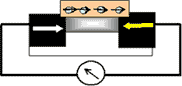
An electronic Maxwell’s demon
It is common to differentiate between two ways of building a nanodevice. There is the top-down approach where we start from something big and chisel out what we want, or a bottom-up approach where we start from something small — like atoms or molecules — and assemble what we want. When it comes to describing current flow, the standard approach follows the "top-down" concept and works its way down from large conductors. This lecture, however, will present a unique "bottom-up" view of electrical conduction that is particularly relevant to today’s nanoscale devices. It will illustrate fundamental questions of transport physics such as wave-particle duality, dissipation, and entanglement, all using a nanoscale device that can sort out and regulate the flow of electrons in a manner reminiscent of the "demon" imagined by James C. Maxwell in the nineteenth-century to illustrate limitations of the second law of thermo-dynamics.
A more updated version of this lecture can be found on the nanoHUB at CQT Lecture 1: Nanodevices and Maxwell's Demon as part of Prof. Datta's 5 part lecture series Concepts of Quantum Transport.
Bio
Dr. Supriyo Datta, received his bachelor of technology degree from the Indian Institute of Technology in Kharagpur, India, in 1975, then earned his PhD at the University of Illinois at Urbana-Champaign in 1979. In 1981, he joined Purdue University, where he is currently the Thomas Duncan Distinguished Professor in the School of Electrical and Computer Engineering. In 1984, he received an NSF Presidential Young Investigator Award and an IEEE Centennial Key to the Future Award. In 1994, he received the Frederick Emmons Terman Award from the ASEE. Professor Datta shared the SRC Technical Excellence Award in 2001 and the IEEE Cledo Brunetti Award in 2002 with his colleague, Mark Lundstrom. Prof. Datta is a Fellow of the IEEE, the American Physical Society (APS), and the Institute of Physics (IOP). He has authored several books, including: Surface Acoustic Wave Devices (Prentice Hall, 1986), Electronic Transport in Mesoscopic Systems (Cambridge, 1995), and Quantum Transport: Atom to Transistor (Cambridge, 2005). His current research interests are centered on the physics of nanostructures and include spin electronics, molecular electronics, nanoscale device physics, and mesoscopic superconductivity.
Research:
Supriyo Datta started his research career in the field of ultrasonics, but after joining the Purdue faculty in 1981, has largely focused on the problem of understanding the flow of electrical current through very small conductors.
The basic problem is a familiar one: A voltage V is applied across two contacts (labeled "source" and "drain" in the figure below) made to a conductor ("channel"). How do we calculate the current I, as the length of the channel L is made shorter and shorter, down to a few atoms?
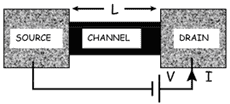
Twenty years ago, such a question was largely academic, but today experimentalists are actually making current measurements through "channels" that are only a few atoms long. Indeed, this is also a question of great interest from an applied point of view, since every laptop computer contains about one billion transistors, each of which is basically a conductor like the one in the above figure, but with an additional terminal (not shown) that can be used to control the resistance (V/I) of the channel. As the channel length L is reduced from macroscopic dimensions (such as millimeters) to atomic dimensions (such as nanometers), the nature of electron transport — that is, current flow — changes significantly. At one end, it is described by a diffusion equation in which electrons are viewed as particles that are repeatedly scattered by various obstacles as they perform a "random walk" from the source to the drain. At the other end, there is the regime of quantum transport, where wavelike interference effects can lead to such non-intuitive behavior as two resistors in series having less resistance than either one alone.
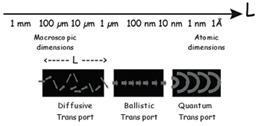
However, this wave behavior is also interlinked fundamentally with the particle nature of electrons, and a proper description of current flow on this scale requires a model that accounts for both. Quantum transport far from equilibrium remains one of the most challenging problems in physics although there has been significant progress in our understanding over the last 20 years and Prof. Datta's approach to this problem is being widely adopted.
Interestingly, this research activity has also had a significant impact on teaching and curriculum development. While developing an undergraduate course on nanoelectronics, it seemed that the typical "top-down" approach starting from the macroscopic limit (large L) was not very effective in conveying our latest understanding to students. Instead, we found a "bottom-up" view starting from the atomic limit (small L) that was far more effective.
We feel that the "top-down" approach that is so common in education is often used primarily for historical reasons — after all, 20 years ago, no one knew what the resistance was for an atomic scale conductor, or if it even made sense to ask about its resistance. But now that the bottom-line is known, a "bottom-up" approach seems appropriate at least to complement the existing "top-down" curriculum. This new approach to education is not exclusive to the subject of current flow, either — many other topics in science and engineering could also benefit from the concept. The Network for Computational Nanotechnology (NCN), directed by Mark Lundstrom, is getting ready to launch a new initiative to lay the foundations for a "bottom-up" curriculum that can be used to train engineers worldwide.
Sponsored by
Cite this work
Researchers should cite this work as follows:
Time
Location
Stewart Center, Fowler Hall Purdue University, West Lafayette, IN